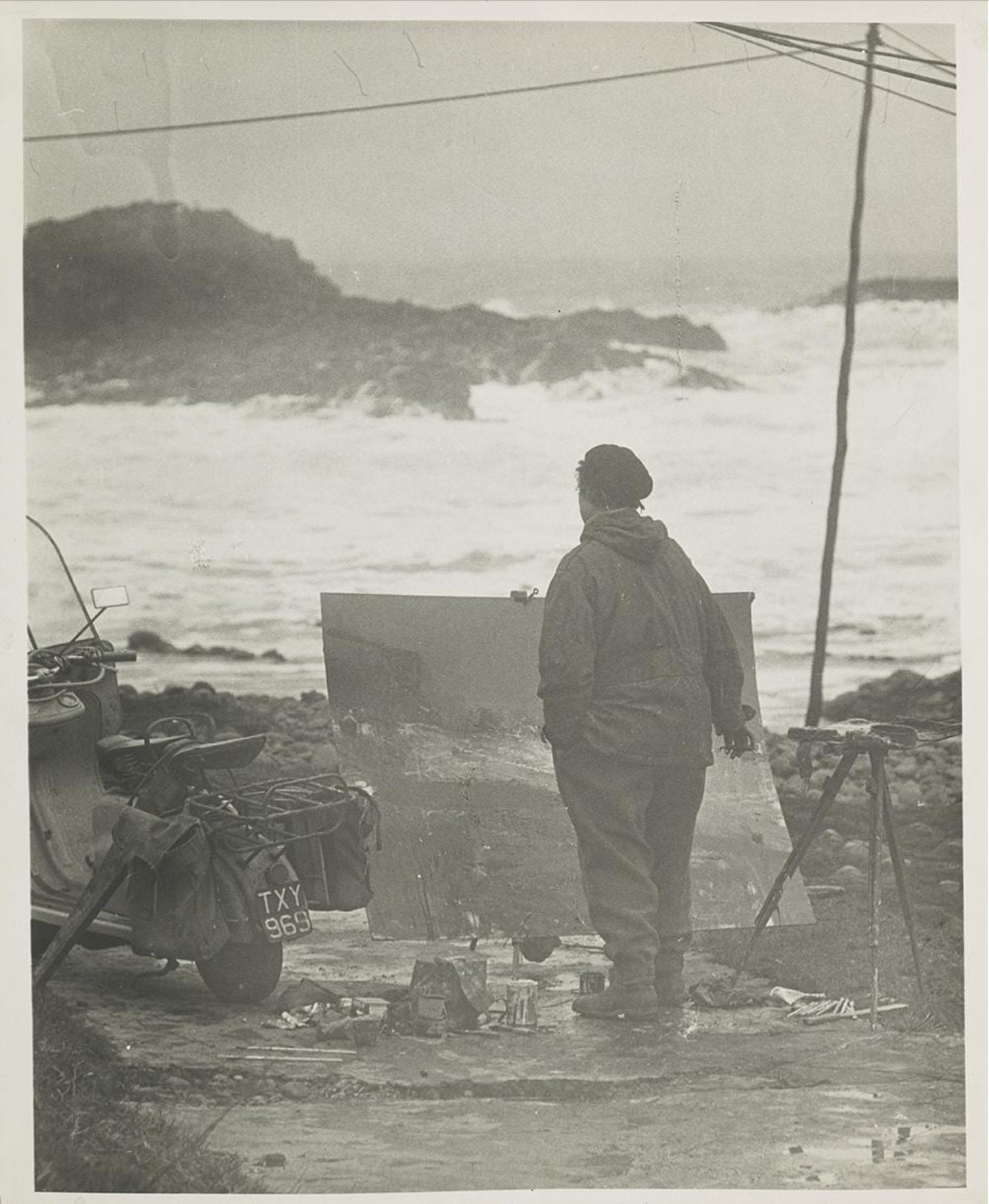
A Burning Frost: Joan Eardley in Catterline
An essay on one of Scotland's best-loved artists and the clifftop village she called home
Sunsets on Scotland’s east coast lack the drama of the west. There is none of that long drum roll before the sun does its vanishing trick. In the east the gloaming is brief. For a short while the evening air takes on a blue tinge. Then darkness.
I arrived at the Airbnb in Catterline late afternoon and, as is my middle-class habit, did an inventory of things I regard as essential for a pleasant stay. Decent kitchen knives. Good water pressure. Suitable methods for making coffee. Basic condiments: olive oil, vinegar, a pepper grinder.
Then I took in my surroundings. They were spectacular. Low cottages were strung along a cliff edge overlooking a semi-circular bay. The effect was theatrical, an amphitheatre. There was a rocky beach and a wet-black stone pier. Just offshore stood an implausible lump of rock maybe 20ft high that locals called the Kale Tap. A short distance out to sea was a ragged reef known as Dunnie Woof, polka-dotted with white gulls.
The North Sea was ash. The horizon was a charcoal line smudged with a thumb. An offshore wind farm, happed in mist, slowly emerged into view. This was a touch disconcerting. It seemed like the windmills were advancing from the haar, heading for land, hunting Quixote.
I was in Catterline for the same reason I sat, as a student with a head full of books, in Les Deux Magots in Paris thinking I was James Joyce. Or got drunk in the White Horse Tavern at the junction of Hudson and West 11th in Manhattan, where Dylan Thomas sipped his final whiskey. Or dawdled with a sketchbook in the dappled garden of Barbara Hepworth’s studio in St Ives, surrounded by her sculptures. Or endured a night of awful death metal in CBGB’s in the Bowery, the bar that gave us the Ramones, Talking Heads and Blondie, and which had a terrifying WC in the gents with no cubicle around it, where you took a shit in plain sight if you dared.
I was here as a culture tourist, something that takes up much of my life despite being something I barely understand. I was in Catterline because it was here Joan Eardley painted some of the works of art I hold most dear. It was here she found something that spoke deeply to her, and I wanted it to speak deeply to me too. My week in a Catterline cottage was part holiday, part research, part seance.
The light was starting to fade when the blue air was interrupted by a different, more insistent blue, artificial and intermittent. A police car was moving at speed down the narrow road that curved to Catterline beach. I walked to the edge of the cliff and looked down.
A car was in the water. Next to the pier. A silver hatchback. Waves up to windows. Three men were struggling out of the sea half-carrying, half-dragging a body ashore. One of the men was holding an arm, one a leg, the third bearing most of the burden. Their movements were awkward and urgent. The body was a dead weight: limp, cumbrous, hard to handle.
They half-placed, half-dropped the body onto the rocky beach. It seemed to be male, above average weight, dark clothing. Immediately a police officer started giving CPR. The jukebox in my head conjured up the Bee Gees song first aiders are taught to time chest compressions. Ha, ha, ha, ha, stayin’ alive, stayin’ alive.
The body was deathly still. I looked away, whether out of respect or self-disgust it was hard to say. I had seen dead bodies before. Sometimes bearing witness to death can be an act of affirmation, a positive moral choice. Not this time. I did not want to watch this man die. Or, if he was already dead, I did not want to watch the futile pummelling of his corpse.
The blue lights of the patrol car were still flashing. Yellow hi-vis stab vests lay on the beach where they had been discarded. There was no clamour. Despite being only a hundred yards away I could hear nothing more than the rattle of the ebb as it pulled on the pebbles in the bay.
Just another Catterline tide.
–o0o–
On Joan Eardley’s first visit to Catterline she was struck by the sight of a child playing with a human skull. It was the spring of 1950 and a 28-year-old Eardley had been staying in Aberdeen, convalescing from a dose of the mumps. A friend took her for a drive south along the coast to get some air. The story of that day is told in Cordelia Oliver’s 1988 monograph:
“Driving down the narrow Catterline road they stopped and went into the churchyard, where they found a gravedigger at work, a garrulous old fellow who chuckled and shared his joke with the two young women. He had just discovered that the grave he was digging up was the wrong one. There were children larking about, and one boy unearthed a human skull and stuck it up on a pole. Joan was entranced by the whole experience. ‘This is the real Shakespeare stuff,’ she said. ‘What a place to live.’ And that was before she had seen the village itself, the clifftop cottages, the rocks, the fishing boats, and the sea far below.”
Eardley became a regular visitor and two years after that first sight of Catterline she was offered use of a run-down coastguard cottage known as The Watchie. A local fisherman with a sideline as a taxi driver was asked to go to Stonehaven railway station to pick up “a young lassie”. When he got there he could see no lassie. His eight-year-old son eventually pointed to a chunky figure in jacket and trousers standing with two suitcases and a large box. Women wearing trousers were rare in that corner of Scotland in the 1950s.
Eardley was big-boned, helmet-haired and awkward, about five foot four in height. Her usual mode of dress was a navy blue duffel coat, baggy corduroy trousers and tackety boots. She was so quietly spoken strangers might easily have formed the impression she was timid. Not so. Eardley had within her an urgent intensity, a gathered storm, visible only to those few friends and lovers she allowed to get close.
Joan Kathleen Harding Eardley was born in the market town of Horsham in Sussex in 1921 to William and Irene, who had met in Glasgow during the First World War. William was an army captain who never fully recovered from being gassed in the trenches. After the war he struggled to make a go of a dairy farm and the family ended up broke. William and Irene split. When Joan was seven her father took his own life, aged 41, a trauma she rarely talked about and seems never to have fully processed as an adult.
Irene took Joan and her younger sister Pat to live in Auchterarder, where they had family, and then to a house in Bearsden, a snug suburb of Glasgow. After school she enrolled at Glasgow School of Art where she made an immediate impression on Hugh Crawford, the head of drawing and painting.
Crawford insisted his students dig deep.
“If you want to be a good painter, you have to be prepared to break down some barrier within yourself. In Scotland we are all born with a constraint of this kind - we get it with our mother’s milk. Somehow we have to enter into another plane of living, to break through, or away from Scottish morality - the vulgar idea of godliness…You have to accept there’s a kind of necessity before which everything else has to go down.”
Eardley would spend a lifetime with this as a lodestar. She had much to break down. Depression and despondency dogged her. Among her most prized books was Robert Burton’s three-volume Anatomy of Melancholy, published in 1621, which gave us the woe-begotten line: “Thou canst not think worse of me than I do of myself.” In letters to friends she talked about “a terrible, helpless, hopeless feeling” with some days a “dreadful, unending struggle”. She was prone to episodes she described as “a sort of breakdown”. Her response was to throw herself at her work with an almost violent relentlessness. Eardley was simultaneously broken and under repair, and always would be.
Success came quick and easy. Prizes, scholarships and travel bursaries were lavished on her. A critic for the Glasgow Herald praised her work’s “dusky confusion”. Some press attention was less welcome. A painting of her friend Angus Neil asleep naked on a bed earned a headline in the Sunday Express: “This sleeping man has (ooh!) no clothes.” This led to some unwanted attention: a number of men contacted Eardley to offer their services as naked models.
Eardley was making her mark, one way or another. And yet she felt restless in Glasgow and needed an escape. Then, as now, the city’s art world could be cliquey, petty and vicious. Eardley seemed to bring out the worst in some establishment critics. A painter called Robert Westwater wrote about Eardley in the Scottish Art Review, making great play of the masculinity he detected within her work:
“For all I know Miss Eadley may be a slender and willowy blonde. The strength of her work may be just one of those curious inversions sometimes found in women artists. But I am willing to take a fair sized bet that, in fact, she is a straight-browed, strong-jawed brunette, with physique equal to that of most men.”
This is a sour little paragraph. You can guess from the tone that Westwater was well aware of Eardley’s appearance, and perhaps her homosexuality too. Oh, how they must have sniggered in the billiard room of the Glasgow Art Club, a private members establishment on Bath Street that did not admit women until 1983.
Patrick Elliott, chief curator of modern and contemporary art at the National Galleries of Scotland, whose definitive study of Eardley in Catterline was an essential source for this essay, suggests various reasons why she might have been made to feel unwelcome in Glasgow. Was it because she was gay? Was it because she was a woman? Was it because she was English? Was it because she was becoming successful? Any or all of these might have been at play. Whatever the problem, Catterline was the solution.
In 1954, after much to-ing and fro-ing between city and seaside, Eardley moved into the end dwelling of a row of ten cottages that clung higgledy-piggledy to Catterline’s cliff edge. The address was 1 South Row and rent was £1 a year. The house had bare earth floors and a chemical toilet out the back. Eardley wrote to a friend that it was “a strange, strange place” that suited her perfectly.
“It is a great wee house. The floor is all levels at once. And the table three tarry boards nailed together. There’s a great big bed, half wood and half spring. A grannies’ pot, a bucket, a basin, and that’s about all, except for three lovely wee chairs.”
The letter ended with six words now indelibly associated with Eardley’s time in Catterline. You can find them on a commemorative plaque at the Creel Inn, the village pub, and another on the whitewashed wall of the salmon bothy down by the pier:
“I think I shall paint here.”
–o0o–
Early in 2023 an Eardley painting came up for sale at McTear’s, a Glasgow auction house that traces its history back to the mid 19th century. Sea, Cliffs and Lighthouse was painted sometime between 1960 and 1963. Many of Eardley’s seascapes were painted from the beach, close to the shoreline. She especially liked trying to capture the wall of water produced in rough weather when a big wave smacked against the pier. This painting was different, a wider-angle view from a higher vantage point looking south to the Tod Head lighthouse. A storm is conjured in broad sweeps of grey and cyan, grounded by brown grasses in the foreground. McTear’s estimated the price at between £20,000 and £30,000. The listing in the auctionioneer’s catalogue came with a warning. The painting had been “altered”.
The Herald newspaper takes up the story:
“It was sold by Bonhams, in Edinburgh, in 2014, from the estate of the late professors Sir Kenneth and Lady Noreen Murray with the gallery title of Catterline Seascape. However, there were two small dark clouds in the central area that they found to be distracting so a professional conservator was employed to paint over these patches with a lighter shade. Should any purchaser wish to revert the picture to its original state, the assumption is that removing the small area of over-painting would be a relatively straightforward procedure for a professional conservator.”
A reporter tracked down the restorer who made the changes. Julie Hopkinson, an artist from Chesterfield, was quoted as saying:
“The painting was brought into my workshop by the owners several years ago. The owner was not happy with some marks on the area and did not like the clouds in question as they thought it drew unnecessary attention to that area. The marks could not be removed without damaging the oils and the owners did not like the clouds so at their request I did some over-painting to blend in with the sky which they were highly satisfied with.”
The paper asked the opinion of another restorer, Brian McLaughlin. “Some would argue that a painting should be left as an artist intended it to be and in this case it would be with the clouds in,” he said, with admirable restraint. “However, any conservator would ensure that the alterations were easily reversible.”
In comments under the story on the Herald website, the verdict was mixed. Some readers were horrified. But a man called Eric ventured: “Good to see that at least some people buy paintings because they like them, and would like them even better with a couple of splodges removed, and not just because they are by a big name.” A reader called David chipped in: “The ‘restored’ version looks better. No contest. The black blob looked totally wrong. Perhaps Joan dropped a blob of paint in error and couldn't be bothered cleaning it off or perhaps she was just having a Tracey Emin moment.”
The paper printed before and after images. The “small dark clouds” were a black rectangle, probably no more than a couple of dabs of a medium-sized brush, alongside a larger smudge of dark grey. Neither, admittedly, looked like a cloud. Yet when you looked at the tampered version, with the black mark covered by white paint and its grey companion blended tastefully into the surrounding sky, the painting seemed lacking. The original marks were necessary. They gave the sky its weight and its menace. They gave the picture its necessary tension.
Too much tension for the picky owners. Too much weight. Too much menace. They wanted a pleasant landscape, light on the eye, a seascape in which the storm would soon blow over. The artist’s intent was secondary to the purchaser’s requirements.
The art trade is fascinating but weird. A minute’s walk from the front door of my home in Edinburgh is Dundas Street, which runs north-south through the Georgian New Town. Here you will find most of the capital’s commercial art galleries. At my last count there were 11 of them, of varying size and grandiosity. The grandest is The Scottish Gallery, which traces its history back to 1842 when it was known as Aitken Dott, and is run by the grandson of SJ Peploe, the celebrated Scottish Colourist. The smaller operations have barely enough wall space for a dozen modest canvases. I spend too much time wandering between them all and have done for almost 30 years.
One day I was speaking to a gallery owner and he told me green paintings do not sell. Why not, I asked him. “Because nobody has a green living room,” he said. People tended to buy paintings that matched the way their home was decorated, he explained. And one of the dirty secrets of the art world, at least at the modest level of small commercial galleries like his, was that art was part of the home decor business. Sure, not all customers thought this way, but enough for it to be a commercial consideration. For many buyers, a painting had to work with the room in which it hung. The palette had to be compatible with the soft furnishings, or the curtains, or the carpet.
My friend’s other controversial view was that people who knew little about art tended to buy landscapes. Not everyone felt they had the cultural capital to hang a bold piece of abstract expressionism on their living room wall. Much safer was a painting that actually looked like something: a field or a mountain or a cityscape or a farmhouse or a river or a beach. These at least offered a handle for the viewer to grasp. Consequently, he said, landscapes were easier to sell. Sure enough, on a random day I did a rudimentary survey. Around half of the galleries on Dundas Street were selling mostly landscapes. A couple of them rarely sold anything else.
My gallerist friend seemed to be saying landscapes were less serious than other forms of art: safer, not as profound, with less to say about the human condition. This, I thought, was a bit much. Vincent Van Gogh’s skies spoke disturbingly of mental turmoil. Peter Doig, by some margin Scotland’s most successful contemporary artist, produced landscapes full of menace and mystery. His painting The Architect’s Home in the Ravine sold at Sotheby’s for $20m in 2018. I recoiled from my friend’s broad-brush judgment. Yet at the same time it snagged on a nail in my mind.
There is a style of painting ubiquitous in Scotland. I call it The Day-Glo Glen. These are landscapes. Their subject matter is conventional: pretty bays; farmhouses; sunsets over jagged mountains. The Eardley influence is unmistakable, often in the framing. Squint cottages. A harvest field. A foreground of tangled grasses. What makes these paintings distinctive is their palette: Dundee United tangerine; Yves Klein blue; green-screen jade. All highly saturated.
The man behind this style is John Lowrie Morrison, better known as Jolomo, which is how he signs himself on his works. Madonna, Sting and the Duke of Argyll are among those who have hung a Jolomo on their walls. At the peak of his productivity in the 1990s Morrison was producing up to four paintings a day, often completing 100 a month. Twenty years ago some of his canvases were selling for £20,000 apiece. At one stage his framing bill was £250,000 a year. These days Morrison has a side hustle as a lay preacher for the Church of Scotland. He talks of “trying to see the world in a joyful light”.
The Day-Glo Glen is the authorised Scottish national work of art, a genre in itself. It is everywhere and inescapable. You will find it on the wall of your seaside restaurant, your city hotel room, your holiday let, even, as I recently discovered, your local neighbourhood care home for the elderly. You will find greetings cards and prints in every Highland souvenir shop. Jolomo has many plagiarists. Often I’ll think I’ve spotted one of his works, only to find the signature of somebody else. The ultimate compliment, you might say.
The Jolomo style owes a clear debt to Eardley but the two are very different artists. At the start of the 20th century the Fauvists used vivid colour to startle and shock. No such intent seems to be at play in The Day-Glo Glen. The mood is sunny, upbeat, celebratory. A snapshot of the hottest day of an otherwise dreich Scottish summer holiday. There are no black blobs in the skies of Jolomo’s landscapes. No random smudges of grey. There is, in fact, no darkness at all.
–o0o–
The curious case of the missing clouds was not the first time an Eardley picture had been tampered with. Once, in Catterline, Joan left an easel and canvas unattended outdoors and returned to find one of the local children had added some smoke coming out of a chimney.
Village children were drawn to this curious, quiet-spoken English woman who sometimes painted while wearing a fur coat. Perhaps their motive was the sweets Eardley gave them rather than a nascent interest in art. Nevertheless, a retinue of Catterline’s sons and daughters was common whenever Eardley set up her easel.
Ron Stephen, the boy who pointed out Eardley to his taxi driver father at the railway station, later recalled: “This strange person doing something different was exciting. ‘Where’s the artist today,’ we’d say. We would go up to her, two, three, or four of us. It was better in a smaller number because she always had a bag of sweets on her easel. We were totally and utterly unimpressed with what she was painting, but she would chat away and tolerate us.” In summer the number of children was swelled by Aberdonian orphans brought to Catterline by nuns for a seaside holiday.
Eardley split her time between Catterline and Glasgow. She had had a tenement studio in St James Road in Townhead, a half-demolished neighbourhood rife with squalor. She was becoming well-known for her paintings of slum children and in particular the 12 bairns of the Samson family, who lived nearby in a two-room flat.
Skelly-eyed and snottery-nosed, these scuffed wee urchins were painted with great tenderness. The children would knock on her door and ask: “Will you paint me?” Eardley later recalled: “They are full of what’s gone on today - who’s broken into what shop, who’s flung a pie in whose face - it goes on and on. They just let out all their life and energy and I just watch them.”
Both in Glasgow and Catterline, children were a constant in her life. Eardley was in the habit of carting her easel and painting ephemera around in an old pram. As a potent symbol of the role art played in her life this is perhaps a wee bit too much on the nose. Feminists rightly complain when a woman is discussed in terms of her fertility in a way that would not routinely happen to a man. And yet it would be foolish to deny the power of fertility in many women’s experience, recognising Joan Didion’s observation being female necessitates "a dark involvement with blood and birth and death". Whatever the right and wrongs of this, Eardley had a complex relationship with the 1950s notion of motherhood and conventional family life.
The two most significant loves in Eardley’s life were both women who were married and had children. Audrey Walker was the wife of a sheriff. Margot Sandeman was married to a well-regarded potter. Both were artists who, to the outside world, lived in traditional nuclear families. “Though they had husbands,” Eardley wrote to a friend, “which made it necessary for me to take a certain set place in relationship to them, I took this place with a feeling of, if not pride, anyway of security because of my belief that anyway a woman-woman relationship is far superior to any such man-woman.”
And yet observing them living their family lives without her was at times unbearable. Eardley prized her independence. The freedom to live any life she desired in pursuit of her artistic vision was still a rarity for a woman in the 1950s. At the same time, according to some of those who knew her best, she wrestled with an inner torment at being denied a life that was emotionally harboured and anchored. These two feelings were contradictory but both were true. Was Eardley ever broody for children of her own? There is no evidence to suggest she was. Ultimately she knew the pram in the hall would only ever contain oils and turps.
Only recently has Eardley’s homosexuality been openly discussed in the art world. Early books about her did not even mention she was gay, and they were deliberately vague about the nature of key relationships in her life. The same was true of written material that accompanied early exhibitions of her work. Perhaps this was, despite the passage of time and a more enlightened age, an issue of some sensitivity for the family. And yet no appreciation of Eardley would be complete without an understanding of how her sexuality and relationships contributed to her state of mind.
Eardley travelled constantly between Townhead and Catterline, feeding off the contrast between the two environments. Gradually, though, she became dissatisfied with what she saw as the limitations of her paintings of slum children. With figurative painting she was finding it hard to push the boundaries of her art, to “hang between reality and abstraction”, as she described it in a letter to a friend. This elusive goal was much easier to pursue when painting stormy skies, wild seas and ploughed earth. Only in Catterline could she fulfil her destiny as an artist.
-o0o-
In his book The Art of Travel, the philosopher Alain de Botton describes visiting friends in a farmhouse near Saint Rémy in the south of France. His first impressions of Provence, glimpsed from the hire car he picks up at Marseille airport, are not encouraging.
“Though the landscape was not ugly, I could not - after a few moments of scrutiny - detect the charm so often ascribed to it. The olive trees looked stunted, more like bushes than trees, and the wheat field evoked the flat, dull expanses of south-eastern England, where I had attended a school and been unhappy.”
De Botton then finds a book about Van Gogh in the guest bedroom of the farmhouse. The painter came to Provence in 1888, aged 35, and stayed 15 months. During that time he produced some of the world’s most celebrated art. He painted Arles under snow; trees in spring bloom; the Langloid drawbridge over the Arles-Bouc Canal; the Alpilles hills; and, in June, the fields at harvest time. He also painted sunflowers.
For De Botton, the book is a key that unlocks a door. Through Van Gogh’s eyes he begins to see Provence differently. He notices the colours of crops of lavender and wheat. He sees the way the mistral makes the trees move. A cypress tree in a Van Gogh painting looks like “a flame flickering nervously in the wind”. De Botton notes: “Oscar Wilde remarked that there had been no fog in London before Whistler painted it. There had surely been fewer cypresses in Provence before Van Gogh painted them.”
De Botton finds the local tourist office in Arles a masterclass in linking artist and place. “‘Welcome to the land of Vincent Van Gogh’, exclaims a poster with sunflowers in the entrance hall, while the halls inside are decorated with harvest scenes, olive trees and orchards.” There is a Van Gogh trail, and information boards at key locations showing where he planted his easel. Many of the tourists are in Arles specifically because of Van Gogh. De Botton concludes, in his somewhat pedantic manner: “In so far as we travel in search of beauty, works of art may in small ways start to influence where we would like to travel to.”
Is Joan Eardley tourism a thing? Apart from me, do other people come to Catterline in search of an Eardley experience? There is someone I need to ask. Near the end of my stay I spot a man walking past my cottage with a painting under his arm. He is wearing a North Face cagoule spectacularly splattered with paint in the colours of Catterline Bay. He is Stuart Buchanan. I had been hoping to bump into him. I say hello and introduce myself.
Buchanan, 53, is an artist who lives in Eardley’s old house on the clifftop and has been painting in The Watchie studio since 2008. He has been coming to Catterline since he was 12, when he would visit an aunt and uncle who had a house on South Row. Buchanan has won critical acclaim for his other-worldly paintings of figures in unsettling dreamscapes. Eventually he moved his family to Catterline from Glasgow. Occasionally he paints Catterline landscapes from the same vantage points used by Eardley and he is often interrupted in his studio by Eardley tourists.
“People are so fucking rude, man,” he tells me. “They literally walk in while I’m working and go: ‘Oh, is this where…?’ And they bring their camera out and say: ‘Do you mind if I take some pictures?’ And I’m like: ‘This is my studio. This is not a museum. Nobody asked you to step over the threshold.’”
Why does he think Eardley fans come to Catterline? “They want to stand in the places where she painted,” he says. “I think they want to get a sense of what they’ve seen in the paintings, and the nice thing is, they get that. The village still looks much like it did in the 50s like you see in paintings.”
I tell him about a friend of mine, an Eardley fan who came to Catterline for the first time and, stepping out onto the cliff path and recognising the views she knew so well, burst into tears.
Buchanan understands this reaction entirely. “Her paintings connect with people, whether it’s just a seascape or whether it’s two slum kids or whatever. And that’s a rare trick. I mean, she’s not trying to connect to people, it’s coming straight from the heart. They’re so immediate. There’s only a small bracket of artists that connect, like [L.S.] Lowry. They’re beloved, you know? I don’t know anyone who’s a painter that hasn’t looked at a Joan Eardley and thought: ‘Yeah, that’s the fucking real deal.’”
Buchanan thinks tourists take away both a sense of the place and a sense of the artist. “You could look at equivalents, say, Frank Auerbach’s London, or David Hockney and his English countryside. If you stood at these locations, you would get a sense of what it is that he’s seeing. Because I think that’s what the artist does. They’re just transcribing what’s in front of them, but also putting a sense of themselves into it. It’s a combination of the place and how the artist presents it, and how the artist presents it is singular to them.”
Living in Eardley’s house and working in her studio, Buchanan believes he has come to an understanding of her relationship with Catterline. “When you listen to her speak in interviews and stuff like that, there’s always a melancholy there,” he says. Catterline was somewhere she could work through the pain. “The village people took to her because they could see that she had a work ethic. They’re working people and fishing is bloody hard, dangerous, and here comes this tackety-booted, dungaree-wearing woman, and they could see that she was genuine. She connected with them, just like her paintings do. She wasn’t bullshitting anyone. They could see that she was not afraid to go and, like, hammer a plywood panel onto the roof when the wind blew. So I think they just go: ‘Aye, she’s all right, we’ll give her a break.’ Because you could quite easily just parachute into this community and people would have been: ‘Who the fuck is this? I’m not having that, like.’”
–o0o–
In December 2022 the New Statesman asked a number of writers to choose their favourite artworks depicting winter. Ali Smith, the Inverness-born novelist who has four times been shortlisted for the Booker Prize, chose Eardley’s Catterline in Winter.
“It’s a picture of dark weighed against light, and vice versa. The tension between the two sends elements and opposites hurtling into symbiosis. It sends how we live – that string of cottages – into a huddle for warmth, for the fun or the terror of the collide, the braced concertina of the slide down the icy slope. Is it night or day? Is that a sun or a moon? When you look closely at that disc of light in the grey it reveals planetary nature as a vital blur, and as something always on the move, the life in it won’t settle to neat geometry. It’s in mid-trajectory, descent and ascent both at once in the slingshot of the dark, sending tiny splinters of itself out into new constellations. The sea and sky are the same thing under it, no place where one ends and the other begins.”
The painting is also the inspiration for an extraordinary piece of modern orchestral music by Helen Grime, a celebrated Scottish composer. Her Catterline in Winter was premiered in the 2016 Proms by the BBC Scottish Symphony Orchestra under Thomas Dausgaard and was shortlisted for a British Composer Award. Grime, who spent some of her childhood in Macduff, a village on the Moray coast, was familiar with Eardley’s work from being taken to galleries in Edinburgh as a child. Grime’s piece is agitated, dissonant, unmoored. The strings swoop like February snowstorms. There are deep furrows and undertows. Bad things are happening. The work could be the soundtrack to a Hitchcock psycho-horror. What Grime tried to convey, she told interviewers, was bleakness.
Eardley’s Catterline in Winter is painted on a square canvas rather than a horizontal rectangular one. Eardley adopted the square late in her career and it proved transformational. It changed the way she painted in a profound way. The technical reasons are easily explained by anyone with an old-fashioned twin-lens reflex camera that shoots square pictures on 120mm film (I am the proud owner of a beautiful Rolleiflex 2.8f TLR that is older than I am). Or, alternatively, any teenager on Instagram.
We see the world in a 4:3 horizontal aspect. In landscape format the key decision is where an artist or photographer places their subject along a horizontal axis. A square is different. A square is an artificial view of a rectangular world. It forces us to make a more conscious decision about framing. Rather than just paint what we see before us, we have to choose what to include. It requires more attention to the relationship between foreground and background. It forces the artist or photographer to think about depth. This is why Instagram, which favours a square format, can be such a liberating medium for traditional 35mm photographers used to seeing the world longways, whether horizontal or vertical.
Eardley adapts to the square by focusing more on what is immediately in front of her, at her feet. This produces greater depth of field. Grasses are detailed up close in the foreground, buildings and crops are pushed further back. The effect is extraordinary. Eardley seems to step into the frame. These are no longer landscapes seen from a distance. Instead they place the painter and the viewer in the scene itself. Her new technique adds perspective, in both senses of the word.
Patrick Elliott, in his book about Eardley in Catterline, speculates the square may have been a practical choice given her chronic back pain. By 1957 this required her to wear a neck brace. Eardley is often in intense discomfort while painting. A square canvas, suggests Elliott, means she does not have to “turn her head or twist or stretch”. Pain dictates more than the shape of Eardley’s canvas. Pain, actual and existential, is a creative force in her final works. Pain is prussian blue mixed with white and black.
Early in her time in Catterline, Eardley wrote to a friend about winter’s allure. Her writing could sometimes be bland and ponderous, but not on this occasion. “Such a clearness, and a brightness and a whiteness - a hoar frost making grasses into fairy feathers and fans, and jewelled stars,” she wrote. “And lasting all day sparkling and glistening in the sun. And frozen butts and taps with shining icicles…the land is so exciting in this weather.”
By 1963 the same weather speaks to Eardley in a very different way. She is a changed woman. She has loved and lost. She lives with chronic pain. She endures bouts of depression that leave her unable to get out of bed. By early 1963, at the time she is working on Catterline in Winter, she is dying of breast cancer, although for a time it is unclear to what extent she realises how gravely she is ill. Soon she will lose her sight.
Her final London exhibition, at the Roland, Browse & Delbanco gallery in Cork Street, is a sensation. The actor Dirk Bogarde buys two of the paintings. The critic from the Manchester Guardian ranks Eardley alongside Turner. Yet by early summer all she can do is sit outside her cottage with a red spotted handkerchief covering her eyes to keep out the glare of the sun. She spends days staring sightless over the bay.
As her condition worsens, Eardley’s family decides she should be moved back to Glasgow. Eardley dies in Killearn Hospital, a wartime facility a few miles from Loch Lomond, on August 16, 1963. She is 42 years old. Her ashes are brought back north and scattered on the rocky beach next to the black stone pier.
Just another Catterline tide.
Catterline in Winter is a matter of life and death. Like Van Gogh’s starry, starry night this is not a physical landscape but a psychological one. It is Eardley’s final reckoning. The cliff-edge of Catterline is painted by a woman approaching the end of her road.
Is this a painting of darkness? Or light in the darkness? A human skull on a pole? Or children’s laughter in a graveyard? In that piece for the New Statesman, Ali Smith wonders if the huddle of cottages in Catterline in Winter are tumbling downhill or whether they are, in fact, despite everything, pushing uphill.
“In the bleakest midwinter the frozen grass in the field is almost alight, a conflagration of shards of unexpected colour warming to something resembling harvest, a burning frost, and this warmth gestures towards the topmost cottage on the weather-hurtled street, which happens to be number 1 South Row, one of the houses the painter Joan Eardley lived and worked in, in the late 1950s and early 1960s, in the Scottish north-east coastal village of Catterline. That distant end house sends out a haze of faint light or heat like something is opening round it. Maybe the street isn’t on a downward slide after all, maybe it’s shoving upwards towards that warm outbreath.”
Smith’s verdict on Eardley in Catterline feels like a final word:
“Her paintings send you reeling with the power, the colour, the calm, the beauty, the fused dark and light of how things really are. Here’s a rough dark winter at the end of a road that becomes so bright it’s near luminous.”
-o0o-
I enjoyed my week in Catterline. Time drifted as I sat on the clifftop watching the weather roll in, checking the identity of passing ships on a smartphone app. There are some good walks. The Creel Inn does a robust take on bistro seafood. At one of the tables you sit underneath a small Eardley oil of fishing nets drying on the shore. You could easily miss it. The village is not eager to please. It wears its fame lightly. You take it as you find it.
I set out to discover what in Catterline spoke to Eardley. I wanted it to speak to me too. Did it? Yes, I think it did. Taking the photographs that accompany this essay helped. You might call it method tourism. Patrick Elliot’s book contains a useful map showing where Eardley stood while painting 33 of her Catterline works. You can plant your feet at the exact spot where she painted Catterline in Winter and ponder the decisions she made in committing the scene to canvas. You understand better both the art and the artist.
As for the seance, was it successful? Did the lights flicker and the table shake? Did the upturned glass move to the letters and spell out a message? In a way, yes. Reading about her life in the place she called home meant I did not have to picture the scene, I could just look up from the page. Like De Botton, I saw the land anew.
Doubtless some might visit Catterline and feel nothing. You have be open to an epiphany to have a chance of experiencing one. In Stephen Hero, Joyce defines an epiphany as "a sudden spiritual manifestation, whether in the vulgarity of speech or of gesture or in a memorable phase of the mind itself”. As an atheist I flinch at “spiritual”. And yet I recognise my art tourism carries more than a whiff of Catholic pilgrimage. Maybe I am seeking a secular source of plenary indulgence.
Les Deux Magots. The White Horse. St Ives. CBGB’s. Catterline. Where next? Perhaps Frida Kahlo’s house in Mexico City? Or John Keats’s last dwelling place at the bottom of the Spanish Steps in Rome? And to what purpose?
I have come to acknowledge that for me art is a kind of sacrament. At Catholic primary school in the 1960s we had to learn the Penny Catechism by rote. I can still recite it. Who made me? God made me. Why did God make me? God made me to know him, love him and serve him in this world, and be happy with him forever in the next. A few pages later it defines a sacrament by paraphrasing St Augustine, who in the 5th century said it was “an outward and visible sign of an inward and invisible grace”.
As an explanation of why I was in Catterline, St Augustine helped. Eardley’s paintings are the outward sign of an inward grace. In Catterline I caught a glimpse of both.


What a truly beautiful and moving piece! I am sure I will return to it many times. Thank you.
Thank you for reposting this one - I am already looking forward to reading it again.
Jake